Imagine this. You are no longer in this world. Your body is in the grave. Your accounts are closed. Your phone is switched off. And yet, somehow, your book of good deeds is still being written. Every single day, rewards keep flowing into your account of akhirah. No effort from your side. No action. Just the quiet, continuous echo of something good you did while you were alive.
This is not a fantasy. This is Sadaqah Jariyah. The Prophet Muhammad (peace be upon him) said: "When a person dies, their deeds come to an end except for three: ongoing charity (Sadaqah Jariyah), knowledge that benefits others, and a righteous child who prays for them." (Sahih Muslim, 1631). Three things. That is all. And the first one, ongoing charity, is entirely within your control right now, today, in this very moment.
At IQRA Welfare Trust in Madanpur Khadar, New Delhi, we have seen the power of Sadaqah Jariyah transform entire communities. A child sponsored today becomes a teacher tomorrow. A water well built today quenches thirst for decades. A medical camp funded today saves a mother who raises five children. The ripple effects are endless. And so is the reward, InshaAllah.
What This Guide Covers
What Is Sadaqah Jariyah and How Is It Different from Regular Sadaqah?
The word Sadaqah comes from the Arabic root "sidq," meaning truthfulness. It is any voluntary act of charity done sincerely for the sake of Allah. When you give a hungry person a meal, that is Sadaqah. Beautiful, rewarded, but the benefit ends when the meal is finished. One meal, one reward.
Sadaqah Jariyah adds the word "Jariyah," which literally means "flowing" or "running," like a river that never stops. It refers to charity whose benefit continues to flow to people long after the initial act. When you sponsor a child's education, that child learns to read today, gets a job in ten years, teaches their own children in twenty years, and contributes to society for a lifetime. Your single act of charity keeps producing benefit, and your reward keeps flowing, for as long as that chain continues.
Regular Sadaqah
- One-time benefit, one-time reward
- Example: giving food to a hungry person
- Reward is earned once
- Still highly virtuous and encouraged
Sadaqah Jariyah
- Continuous benefit, continuous reward
- Example: sponsoring a child's education
- Reward flows even after death
- The ultimate investment for akhirah
What the Quran and Hadith Say About Ongoing Charity
The concept of Sadaqah Jariyah is firmly rooted in Islamic scripture. Here are the most important references every Muslim should know.
Sahih Muslim 1631
"When a man dies, his deeds come to an end except for three things: Sadaqah Jariyah (ceaseless charity); a knowledge which is beneficial, or a virtuous descendant who prays for him."
— Narrated by Abu Hurairah (RA)
Surah Al-Baqarah 2:261
"The example of those who spend their wealth in the way of Allah is like a seed [of grain] which grows seven spikes; in each spike is a hundred grains. And Allah multiplies [His reward] for whom He wills."
Scholars like Imam Nawawi and Ibn Hajar have explained that Sadaqah Jariyah includes building mosques, digging wells, planting trees, constructing hospitals, spreading beneficial knowledge, and supporting education. The common thread is that the benefit outlives the act of giving.
7 Best Sadaqah Jariyah Projects in Delhi NCR You Can Support Today
Based on years of ground work in Madanpur Khadar, Okhla, and Shaheen Bagh, here are the most impactful Sadaqah Jariyah projects available through IQRA Welfare Trust.
1. Child Education Sponsorship (Highest Impact)
This is the closest modern equivalent to the "beneficial knowledge" mentioned in the hadith. When you sponsor an orphan child's education for ₹500/month, you are not just paying school fees. You are setting in motion a chain of knowledge that can span generations. That child grows up, earns a halal income, educates their own children, and possibly teaches others. Every link in that chain traces back to your initial act. Our orphan child sponsorship programme currently supports children across Madanpur Khadar and Okhla schools.
2. Clean Drinking Water Access
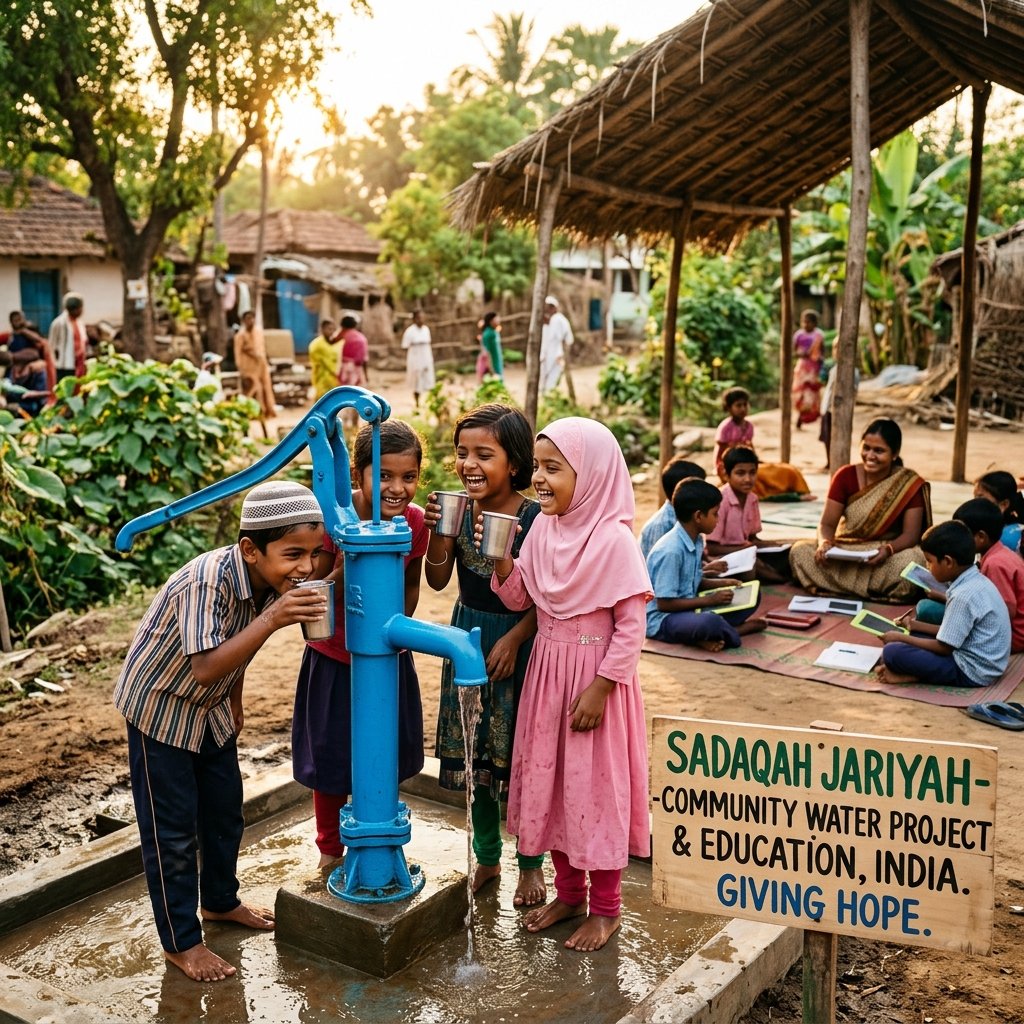
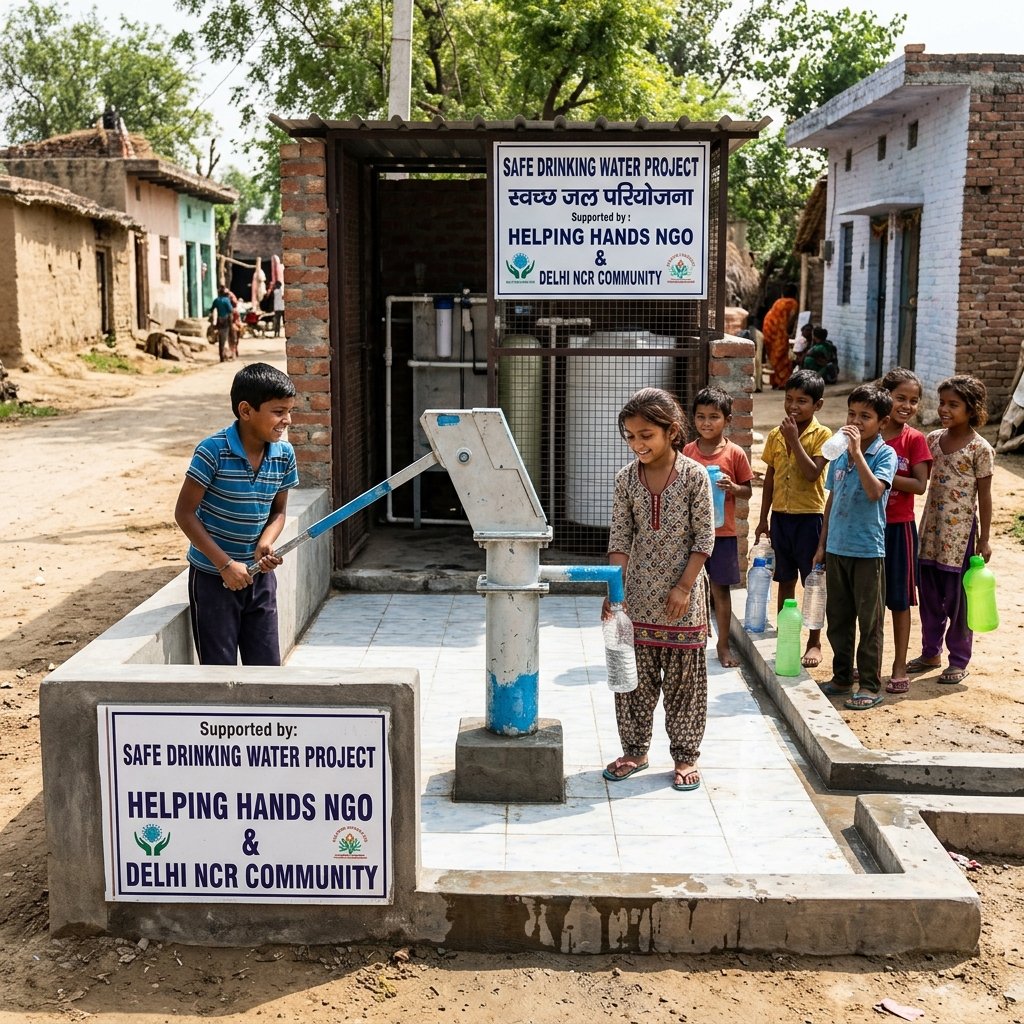
The Prophet (PBUH) was asked: "Which Sadaqah is best?" He replied: "Giving water." (Sunan Abu Dawud, 1679). In the slums of Delhi NCR, clean water remains a daily struggle. Families walk long distances, children miss school to fetch water, and waterborne diseases are rampant. Funding a water purification unit or a community water point is a Sadaqah Jariyah that serves hundreds of people daily for years.
3. Free Medical & Eye Checkup Camps
A child who cannot see the blackboard will eventually drop out. An elderly person who cannot afford medicine will suffer in silence. Our free medical and eye camps in Madanpur Khadar provide computerized eye tests, free spectacles, general health screenings, and medicines. Funding a single camp (₹15,000–₹25,000) serves 300–500 patients. Every pair of spectacles given is a Sadaqah Jariyah that helps a child study for years.
4. Monthly Food Ration for Orphan Families
While a single meal is regular Sadaqah, sponsoring a family's monthly ration pack (₹1,500) for an entire year creates sustained benefit. A well-nourished child attends school regularly. A healthy mother can work and support her family. Our ration distribution programme prioritises widowed women, orphan families, and elderly citizens without support in Delhi NCR.
5. School Kit Distribution Drives
A complete school kit (bag, notebooks, uniform, shoes, stationery) costs ₹800–₹1,200. When you fund these kits at the start of an academic year, you remove the single biggest barrier between a slum child and a classroom. The kit lasts the entire year. The education lasts a lifetime.
6. Winter Clothing & Blanket Distribution
Delhi winters are brutal for families living in tin-roofed jhuggis. Children fall sick. Elderly people suffer from joint pain and hypothermia. Donating warm blankets, sweaters, and jackets before winter (November–December) is a Sadaqah Jariyah that protects health for an entire season and prevents school absences due to illness.
7. Quran & Islamic Education Support
Supporting a child's Quran education at a local madrasa is among the most powerful forms of Sadaqah Jariyah. Every verse that child recites, every prayer they teach their own children, every good deed they perform based on Islamic knowledge, all of it adds to your book of deeds. This is the "beneficial knowledge" the Prophet (PBUH) specifically mentioned.
Sadaqah Jariyah Cost Comparison
Sadaqah Jariyah on Behalf of Deceased Parents: A Complete Guide
One of the most common questions we receive at IQRA Welfare Trust is: "Can I give Sadaqah Jariyah on behalf of my deceased mother or father?" The answer is a resounding yes, and it is one of the most beautiful acts of birr al-walidayn (kindness to parents) a Muslim can perform.
A man came to the Prophet (PBUH) and said: "My mother has died. Will she benefit if I give charity on her behalf?" The Prophet (PBUH) said: "Yes." (Sahih al-Bukhari, 2756). Based on this and other narrations, scholars unanimously agree that Sadaqah given on behalf of the deceased reaches them and benefits them.
Here is how you can do it through IQRA Welfare Trust. When you donate, simply tell us: "This Sadaqah Jariyah is on behalf of my father/mother, [Name]." We will record it in our records and make dua for them during every distribution drive. You can sponsor a child's education in their name, fund a medical camp in their memory, or provide monthly rations as their ongoing charity. The reward, InshaAllah, reaches them continuously.
How to Start Your Sadaqah Jariyah Today (3 Simple Steps)
Choose Your Project
Decide which Sadaqah Jariyah project resonates with you. Child education (₹500/month) is the most impactful. Clean water, medical camps, and ration packs are equally valid. Even ₹100 for a hygiene kit counts.
Contact IQRA Welfare Trust
Call +91-8057610395 or email support@iqrawelfaretrust.in. Tell us your intention, the amount, and whether it is on behalf of someone. We will guide you through UPI, bank transfer, or card payment.
Make Your Niyyah and Trust Allah
Before donating, make a sincere intention: "O Allah, I give this Sadaqah Jariyah for Your sake. Accept it from me and let its reward flow continuously." Then follow our Instagram @munawwar_hasan_45 and @rashidnadwi to see your charity in action.
Start Your Sadaqah Jariyah Today
Your charity does not have to end with your life. Sponsor a child, fund clean water, or support a medical camp. Let your good deeds flow like a river, InshaAllah.
Related Islamic Charity Guides
Frequently Asked Questions About Sadaqah Jariyah
Answers to the most common questions Muslim donors ask about ongoing charity.
Sadaqah Jariyah means "flowing charity" or "ongoing charity." It refers to charitable acts whose benefits continue long after the initial donation, earning the donor continuous reward (sawab) even after death. The Prophet Muhammad (PBUH) said that when a person dies, their deeds end except for three things, and Sadaqah Jariyah is the first of them (Sahih Muslim, 1631).
Child education sponsorship through IQRA Welfare Trust is the most impactful Sadaqah Jariyah in Delhi NCR. For ₹500/month, you sponsor an orphan's complete education in Madanpur Khadar or Okhla. As long as that child benefits from knowledge and teaches others, your reward continues. Other excellent options include clean water projects and free medical camps.
Yes, absolutely. The Prophet (PBUH) confirmed that charity given on behalf of the deceased benefits them (Sahih al-Bukhari, 2756). You can sponsor a child's education, fund a water well, or support medical camps in your parents' name through IQRA Welfare Trust. Simply mention their name when donating, and we record it for dua during every distribution.
It varies by project. Child education sponsorship starts at ₹500/month (₹6,000/year). A family ration pack costs ₹1,500/month. A complete school kit costs ₹800–₹1,200. Funding a free medical camp costs ₹15,000–₹25,000. Even ₹100 for a hygiene kit qualifies as Sadaqah Jariyah. There is no minimum amount in Islam.
Sadaqah is a one-time voluntary charity with a single reward, like giving a meal to a hungry person. Sadaqah Jariyah is ongoing charity whose benefit continues over time, like sponsoring education or building a well. The reward for Sadaqah Jariyah flows continuously as long as people benefit, even after the donor passes away.
No. Zakat is an obligatory annual payment of 2.5% on eligible wealth, with specific recipient categories defined in the Quran. Sadaqah Jariyah is voluntary ongoing charity with no fixed amount or timing. However, Zakat funds can be directed towards Sadaqah Jariyah projects like child education, as long as the recipients qualify under Zakat rules.
IQRA Welfare Trust Team
This guide was prepared by the IQRA Welfare Trust editorial team, led by President Munawwar Hassan and Co-Founder Rashid Nadwi, based in Madanpur Khadar, New Delhi. For Sadaqah Jariyah queries, contact +91-8057610395.