
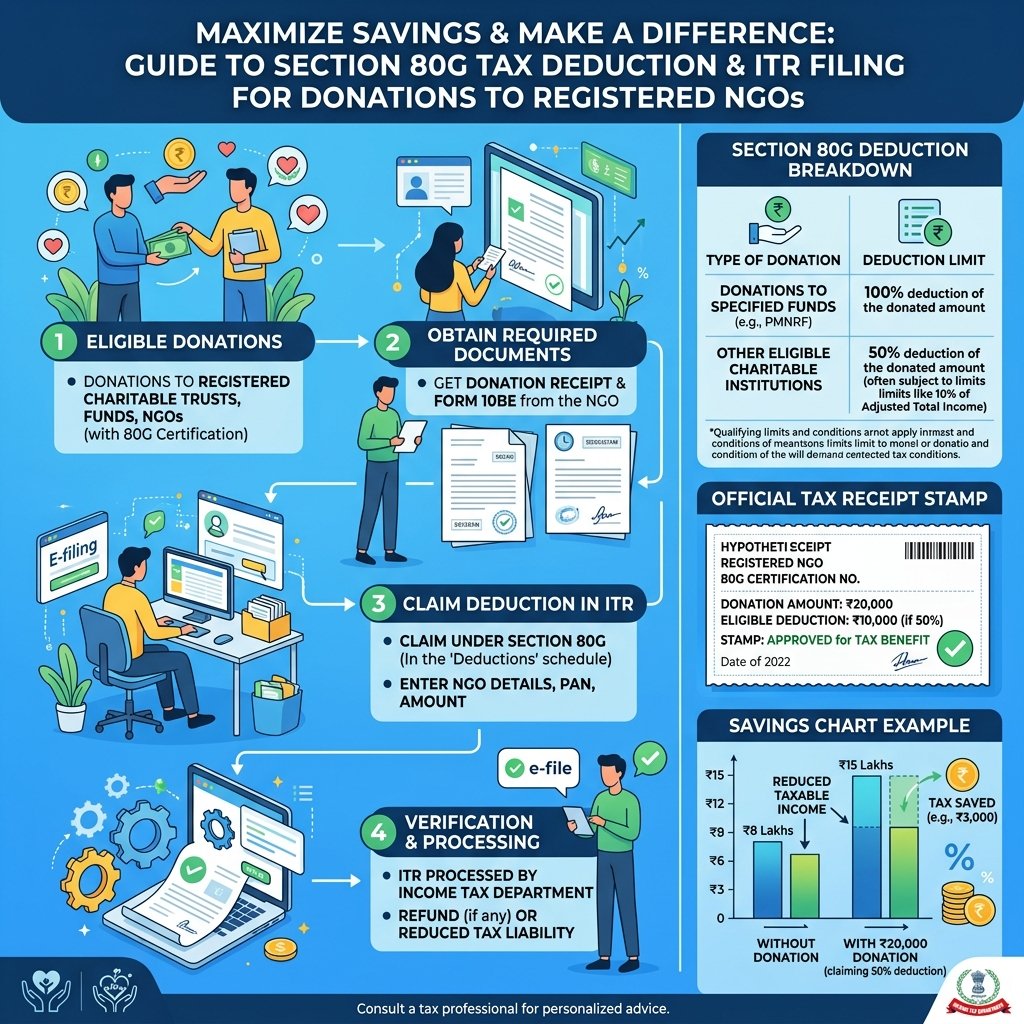
Here is something most Indian taxpayers do not know: the money you donate to a registered NGO can literally come back to you as tax savings. Under Section 80G of the Income Tax Act, every rupee you give to a certified charitable organisation can reduce your taxable income by 50% or even 100%. That means if you donate ₹20,000 to a qualifying NGO, you could save up to ₹6,000 in income tax. You help a child go to school, feed a hungry family, and the government rewards your generosity with a lower tax bill. It is one of the rare situations where everybody wins.
But here is the catch. Not every NGO qualifies. Not every donation receipt works. And if you file your ITR without proper documentation, your 80G claim can get rejected. At IQRA Welfare Trust, we meet donors every week who are confused about 80G rules, fake certificates, and how to actually claim the deduction. This guide, written by our team in Madanpur Khadar, New Delhi, clears every doubt with plain language and real examples.
What This Guide Covers
What Is Section 80G and How Does It Actually Work?
Section 80G is a provision in India's Income Tax Act, 1961, that encourages charitable giving by offering tax deductions to donors. When you donate money to an NGO, trust, or charitable institution that holds a valid 80G certificate from the Income Tax Department, you can deduct a percentage of that donation from your gross total income before calculating your tax liability.
There are two categories of 80G certification. The first is 80G(50%), where you can deduct 50% of your donation amount from taxable income. The second is 80G(100%), where the entire donation amount is deductible. Most NGOs in Delhi NCR, including those working in child education and food relief, hold 80G(50%) certification. A smaller number of government-affiliated funds like the Prime Minister's National Relief Fund qualify for 100% deduction.
There is also a qualifying limit. For 80G(50%) donations without qualifying limit, there is no cap. But for donations with a qualifying limit, the deduction cannot exceed 10% of your adjusted gross total income. Most private NGO donations fall in the "without qualifying limit" category, which is the better deal for donors.
Quick Example
You earn ₹12,00,000 per year (30% tax bracket). You donate ₹20,000 to an 80G(50%) NGO. Your taxable deduction = ₹10,000 (50% of ₹20,000). Tax saved = ₹10,000 × 30% = ₹3,000. Your actual cost for a ₹20,000 donation = ₹17,000. You helped a family, and the government effectively contributed ₹3,000 through tax relief.
80G vs 12A: What Is the Difference and Why Both Matter
People often confuse 80G and 12A, but they serve completely different purposes. Think of it this way: 12A benefits the NGO, while 80G benefits you, the donor.
12A Registration
- Exempts the NGO from paying income tax on its surplus funds
- Issued by the Income Tax Department to the organisation
- Does NOT give any tax benefit to donors
- Every legitimate NGO should have this
80G Registration
- Allows donors to claim tax deduction on donations
- 50% or 100% deduction depending on certification type
- Requires valid receipt with 80G number for ITR filing
- Must be renewed periodically by the NGO
Before donating to any NGO in Delhi NCR, always ask: "Do you have both 12A and 80G registration?" If they hesitate or cannot produce certificates, walk away. At IQRA Welfare Trust, we maintain full compliance and provide donors with proper receipts containing our registration numbers.
Real Tax Saving Calculations: How Much Can You Actually Save?
Let us run the numbers for different income brackets so you can see exactly how 80G works in practice. These calculations assume you donate to an 80G(50%) without qualifying limit NGO, which is the most common type.
| Annual Income | Tax Bracket | Donation (80G 50%) | Deduction | Tax Saved |
|---|---|---|---|---|
| ₹6,00,000 | 5% | ₹10,000 | ₹5,000 | ₹250 |
| ₹10,00,000 | 20% | ₹10,000 | ₹5,000 | ₹1,000 |
| ₹15,00,000 | 30% | ₹20,000 | ₹10,000 | ₹3,000 |
| ₹25,00,000 | 30% | ₹50,000 | ₹25,000 | ₹7,500 |
Notice the pattern: the higher your tax bracket, the more you save. A person in the 30% bracket effectively pays only 70% of the donation amount out of pocket. The remaining 30% comes back as tax relief. This makes charitable giving not just morally rewarding but financially smart.
How to Verify an NGO's 80G Certificate Online (Step by Step)
Fake 80G certificates are more common than you think. Some NGOs photocopy expired certificates. Others fabricate registration numbers entirely. Here is how you verify in under two minutes.
Visit the Income Tax e-Filing Portal
Go to incometax.gov.in and navigate to "Search for 80G registered entities" under the Quick Links section.
Search by Name or PAN
Enter the NGO's exact registered name or their PAN number. For IQRA Welfare Trust, search using the name as registered with the Income Tax Department.
Check Active Status and Validity Dates
Verify that the status shows "Active" and the approval period covers the current financial year. Expired registrations mean your donation will NOT qualify for deduction.
Match the 80G Number on Your Receipt
The donation receipt must carry the same 80G registration number that appears on the portal. If numbers do not match, do not claim the deduction.
How to Claim 80G Deduction While Filing Your ITR
Claiming 80G deduction is straightforward if you have the right documents. Here is the exact process for ITR filing in assessment year 2026-27.
- Collect receipts: Get an official donation receipt from the NGO with their name, address, PAN, 80G number, donation amount, date, and mode of payment.
- Keep payment proof: Save UPI screenshots, bank transfer confirmations, or cheque copies. Cash donations above ₹2,000 do NOT qualify for 80G.
- Open ITR form: Log in to incometax.gov.in and select the appropriate ITR form (ITR-1 for salaried, ITR-2/3 for others).
- Go to Schedule 80G: In the deductions section, find "Donations to charitable institutions" under Chapter VI-A.
- Enter details: Fill in the NGO's name, PAN, 80G registration number, donation amount, and whether it qualifies for 50% or 100% deduction.
- Submit and verify: Complete the filing, verify via Aadhaar OTP or net banking, and keep all receipts for at least 6 years in case of scrutiny.
Important: Cash Donation Limit
Since Financial Year 2017-18, cash donations exceeding ₹2,000 to any single NGO are NOT eligible for 80G deduction. Always donate via UPI, bank transfer, cheque, or demand draft. This is the most common mistake donors make, and it costs them their entire tax benefit.
Donate to IQRA Welfare Trust & Get 80G Receipt
Every donation to IQRA Welfare Trust comes with an official receipt for 80G tax filing. Help children in Madanpur Khadar, Okhla, and across Delhi NCR while saving on your taxes.
Related Guides
Frequently Asked Questions About 80G
Everything donors ask us about tax exemption on charitable donations.
Section 80G of the Income Tax Act allows donors to claim 50% or 100% tax deduction on donations made to registered NGOs and charitable institutions. The NGO must hold a valid 80G certificate issued by the Income Tax Department. The deduction reduces your taxable income, lowering your overall tax liability.
It depends on your tax bracket. If you are in the 30% bracket and donate ₹10,000 to an 80G(50%) NGO, your deduction is ₹5,000, saving you ₹1,500 in taxes. In the 20% bracket, the same donation saves ₹1,000. The higher your income, the more you save.
Visit incometax.gov.in, go to "Search for 80G registered entities," enter the NGO's name or PAN, and check that the status is "Active" with valid dates. Always match the 80G number on your donation receipt with the portal records.
Yes. UPI donations (GPay, PhonePe, Paytm) to 80G registered NGOs qualify for tax exemption. Keep your UPI transaction screenshot and obtain an official receipt from the NGO with their 80G number. Cash donations above ₹2,000 do NOT qualify.
12A exempts the NGO from paying income tax on its surplus. 80G allows donors to claim tax deduction on donations. Both are issued by the Income Tax Department. A legitimate NGO should have both registrations active.
For 80G(50%) donations without qualifying limit, there is no upper cap on the deduction amount. For donations with qualifying limit, the deduction cannot exceed 10% of your adjusted gross total income. Most private NGO donations fall under the "without qualifying limit" category.
IQRA Welfare Trust Team
This guide was prepared by the IQRA Welfare Trust editorial team in Madanpur Khadar, New Delhi. For donation receipts and 80G queries, contact us at +91-8057610395 or support@iqrawelfaretrust.in.