You scroll through your phone. You see a video of children sitting on a footpath, eating roti with salt. You see an elderly woman carrying a heavy bag of rations because nobody is there to help her. Something tightens in your chest. You think, "I want to do something." And then the doubt creeps in. "But I am just one person. I don't have money. I don't have an NGO. Where do I even start?"
Here is the truth that nobody tells you: every major charity movement in Delhi NCR started with exactly one person who decided to stop scrolling and start acting. At IQRA Welfare Trust, our journey began the same way. Munawwar Hassan and Rashid Nadwi did not start with a registered trust, a bank account, and a team of volunteers. They started with a few bags of ration, a borrowed camera, and a burning desire to help the families in Madanpur Khadar. Today, that single act has grown into a movement that feeds hundreds of families, sponsors children's education, and runs free medical camps across Delhi NCR.
This guide is for you. The student who wants to organize a school kit drive in their college. The professional who wants to spend a weekend distributing food. The homemaker who wants to collect winter clothes for slum children. The retiree who wants to give back. Whoever you are, wherever you are in Delhi NCR, this step-by-step guide will show you exactly how to start a charity drive, find volunteers, collect donations, and make a real difference. No experience needed. No registration needed for small drives. Just this guide and your intention.
What This Guide Covers
- Step 1: Choosing the right cause for your drive
- Step 2: Planning your budget and collecting donations
- Step 3: Finding and managing volunteers
- Step 4: Choosing the right location in Delhi NCR
- Step 5: Executing the drive and documenting impact
- Step 6: Partnering with registered NGOs for scale
- Frequently asked questions
Step 1: Choose the Right Cause for Your Charity Drive
The biggest mistake first-time organizers make is trying to help everyone at once. They want to distribute food, clothes, books, and medicines all in one drive. The result? Confusion, scattered resources, and diluted impact. Pick one cause for your first drive. Master it. Then expand.
Here are the most needed and most manageable charity drive categories in Delhi NCR, based on our ground experience.
Food & Ration Drive
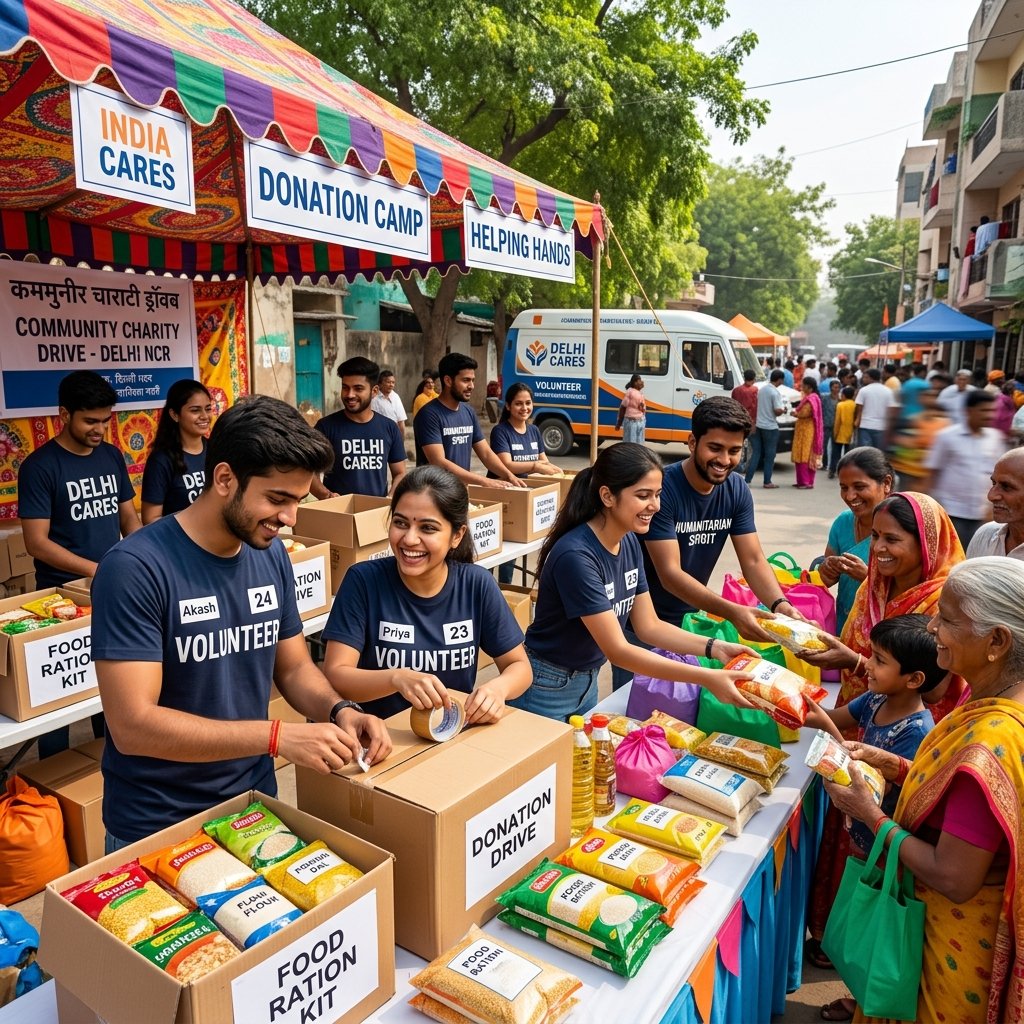
Distribute monthly ration packs (atta, rice, dal, oil) to families. Cost: ₹1,500/family. Best for: beginners, high immediate impact.
School Kit & Education Drive
Distribute bags, notebooks, uniforms, and stationery. Cost: ₹800-₹1,200/child. Best for: students, college groups, long-term impact.
Clothing & Winter Drive
Collect and distribute warm clothes, blankets, and shoes. Cost: ₹200-₹500/person. Best for: October-January, community collection.
Health & Hygiene Drive
Distribute hygiene kits, organize basic health checkups. Cost: ₹300-₹500/family. Best for: medical students, professionals.
Step 2: Plan Your Budget and Collect Donations
Once you have chosen your cause, calculate exactly how much money you need. Be specific. Do not say "we need money for ration." Say "we need ₹45,000 to distribute ration packs to 30 families in Madanpur Khadar." Specificity builds trust. People donate to clear plans, not vague intentions.
Here is a practical budget template for a small-scale ration drive.
| Item | Qty per Pack | Cost per Pack | 30 Families |
|---|---|---|---|
| Wheat Flour (Atta) | 10 kg | ₹450 | ₹13,500 |
| Rice | 5 kg | ₹300 | ₹9,000 |
| Dal (Moong/Masoor) | 2 kg | ₹280 | ₹8,400 |
| Cooking Oil | 1 litre | ₹150 | ₹4,500 |
| Sugar, Salt, Tea | Combined | ₹220 | ₹6,600 |
| Packaging & Transport | — | ₹100 | ₹3,000 |
| Total Estimated Budget | ₹45,000 | ||
For collecting donations, use these proven methods. First, create a simple WhatsApp message with your cause, budget breakdown, and UPI ID. Share it in family groups, college groups, office groups, and mosque/community groups. Second, post on Instagram and Facebook with a short video explaining your drive. Third, ask 5 close friends personally before broadcasting publicly. Personal requests convert 10x better than generic posts. Fourth, if you are partnering with a registered NGO like IQRA Welfare Trust, donors can get 80G tax receipts, which significantly increases willingness to give.
Step 3: Find and Manage Volunteers
You cannot do everything alone, and you should not try to. A charity drive needs at least 3-4 people: one for coordination, one for collection and accounting, one for logistics and transport, and one for documentation (photos/videos). Here is where to find reliable volunteers in Delhi NCR.
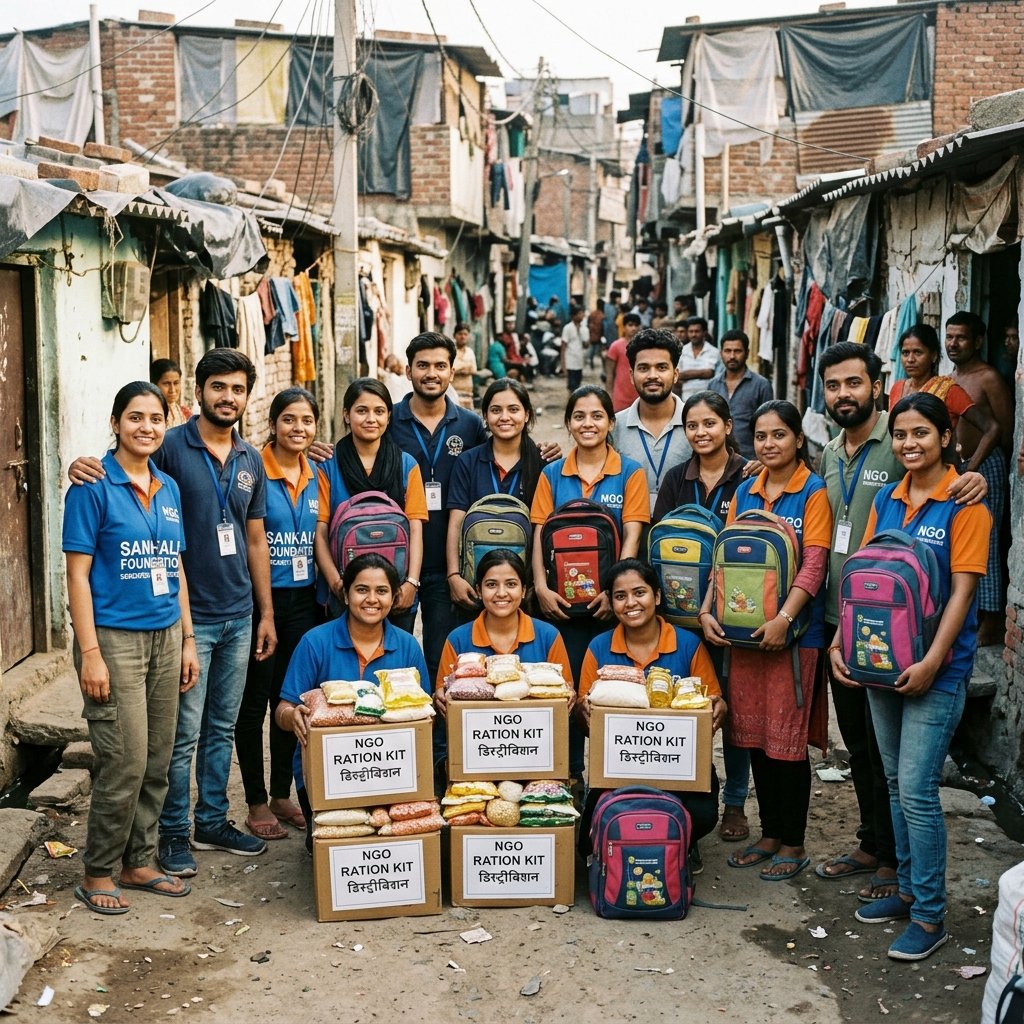
- College NSS/NCC units: Most Delhi colleges (Jamia Millia Islamia, AMU alumni groups, Delhi University colleges) have active NSS units looking for community service opportunities.
- Mosque and community committees: Announce your drive after Friday prayers. Youth volunteers are almost always willing.
- Resident Welfare Associations (RWAs): Many RWAs in South Delhi, Okhla, and Shaheen Bagh actively support charity initiatives.
- Social media volunteer groups: Search for "Delhi NGO volunteers" on Facebook and Instagram. Several active groups connect organizers with volunteers.
- IQRA Welfare Trust volunteer network: We maintain an active volunteer list. Contact us at +91-8057610395 and we can connect you with experienced volunteers in your area.
A critical tip: assign clear roles before the drive day. Nothing kills momentum faster than 10 volunteers standing around asking "what should I do?" Create a simple WhatsApp group, share a task list the night before, and designate one team leader for the day.
Step 4: Choose the Right Location in Delhi NCR
Location determines impact. Distributing ration in an affluent area wastes resources. You need to go where the need is highest. Based on years of ground work, here are the most underserved areas in Delhi NCR where charity drives create maximum impact.
Madanpur Khadar Ext.
High concentration of daily wage workers, orphan families, and children without school access. IQRA Welfare Trust's primary operational area.
Okhla & Jamia Nagar
Resettlement colonies with large Muslim populations, many below poverty line. Good for Zakat and Sadaqah distribution drives.
Shaheen Bagh & Abul Fazal
Dense residential areas with many single-income families. Winter clothing and ration drives work very well here.
Seelampur & Welcome
North Delhi areas with significant poverty. School kit drives and health camps are highly needed.
Before choosing a location, visit it personally. Talk to local elders, mosque committees, or school teachers. They will tell you exactly which families need help most. Never distribute randomly. Create a beneficiary list with names, family sizes, and specific needs. This prevents chaos, ensures fairness, and builds trust with the community.
Step 5: Execute the Drive and Document Everything
The day of your charity drive is where preparation meets reality. Here is a practical checklist we follow at IQRA Welfare Trust for every distribution drive.
Arrive Early and Set Up
Reach the location at least 1 hour before the announced time. Set up a table, arrange items systematically, and assign one volunteer to manage the queue. Chaos at a charity drive destroys dignity. Organized distribution preserves it.
Verify Beneficiaries
Check names against your beneficiary list. If possible, collect a simple acknowledgment (thumb impression or signature). This creates accountability and helps in reporting to donors.
Document with Photos and Videos
Assign one volunteer specifically for documentation. Take photos of every distribution, record short video clips, and capture genuine smiles. This content is gold for social media transparency and future fundraising. Always take consent before photographing faces.
Share Results with Donors Within 24 Hours
Post a summary on WhatsApp and Instagram within 24 hours: how many families were served, total items distributed, photos, and a thank-you message to donors. Speed builds trust. Silence kills future donations.
Step 6: Partner with a Registered NGO for Scale and Credibility
Your first drive might be small. That is perfectly fine. But if you want to grow, collect larger donations, issue 80G tax receipts, and access established beneficiary networks, partnering with a registered NGO is the smartest move you can make.
At IQRA Welfare Trust, we actively welcome partnerships with individuals, college groups, corporate teams, and community organisations. Here is what partnering with us gives you.
- Legal credibility: We are a registered trust with 12A and 80G certification. Donors get tax receipts.
- Ground access: We have established relationships in Madanpur Khadar, Okhla, and Shaheen Bagh. No cold-starting needed.
- Beneficiary database: We maintain verified lists of orphan families, widowed women, and children needing sponsorship.
- Logistics support: Transport, storage, and distribution infrastructure is already in place.
- Social media amplification: Your drive gets featured on our Instagram channels (@munawwar_hasan_45, @rashidnadwi), reaching thousands of potential donors.
- Volunteer network: Access our trained volunteer base for execution support.
Ready to Start Your Charity Drive?
Whether you want to volunteer, organize a drive, or partner with us, IQRA Welfare Trust is here to help you make a real difference in Delhi NCR.
Related Guides
Frequently Asked Questions
Everything you need to know about starting a charity drive and volunteering in Delhi NCR.
Follow these steps: 1) Choose one specific cause (food, education, clothing, health), 2) Create a detailed budget and share it with potential donors, 3) Collect donations via UPI or bank transfer, 4) Partner with a registered NGO like IQRA Welfare Trust for credibility and ground access, 5) Identify target areas like Madanpur Khadar or Okhla, 6) Recruit 3-5 volunteers with clear roles, 7) Execute the drive with proper documentation, 8) Share results with donors within 24 hours.
Contact registered NGOs directly. IQRA Welfare Trust in Madanpur Khadar welcomes volunteers for ration distribution, school kit drives, medical camp coordination, and child education support. Call +91-8057610395 or visit our About page to join. No prior experience is needed, just commitment and compassion. We provide training and assign roles based on your skills.
Costs vary by scale. A small school kit drive for 50 children costs ₹40,000-₹60,000. A ration distribution for 100 families costs approximately ₹1,50,000. A free medical camp costs ₹15,000-₹25,000. You can start small with ₹5,000-₹10,000 for a local neighbourhood drive and scale up gradually as you build trust and donor networks.
For small personal charity drives using your own money, no registration is needed. However, for collecting public donations, issuing 80G tax receipts, or operating at scale, partnering with a registered NGO like IQRA Welfare Trust is essential. Registration under the Indian Trusts Act or Societies Registration Act provides legal credibility and donor trust.
The most underserved areas include Madanpur Khadar Extension, Okhla resettlement colonies, Shaheen Bagh, Jamia Nagar, Seelampur, Welcome, and Trilokpuri. These areas have high concentrations of daily wage workers, orphan families, and children without school access. IQRA Welfare Trust operates primarily in Madanpur Khadar and Okhla.
Absolutely. College students are among the most energetic and creative charity organizers in Delhi NCR. Many drives in Madanpur Khadar and Okhla have been organized by students from Jamia Millia Islamia, AMU alumni networks, and Delhi University colleges. Partner with your college's NSS unit or contact IQRA Welfare Trust for guidance, beneficiary lists, and logistical support.
IQRA Welfare Trust Team
This guide was prepared by the IQRA Welfare Trust editorial team, led by President Munawwar Hassan and Co-Founder Rashid Nadwi, based on years of organizing charity drives in Madanpur Khadar, Okhla, and Shaheen Bagh, Delhi NCR.